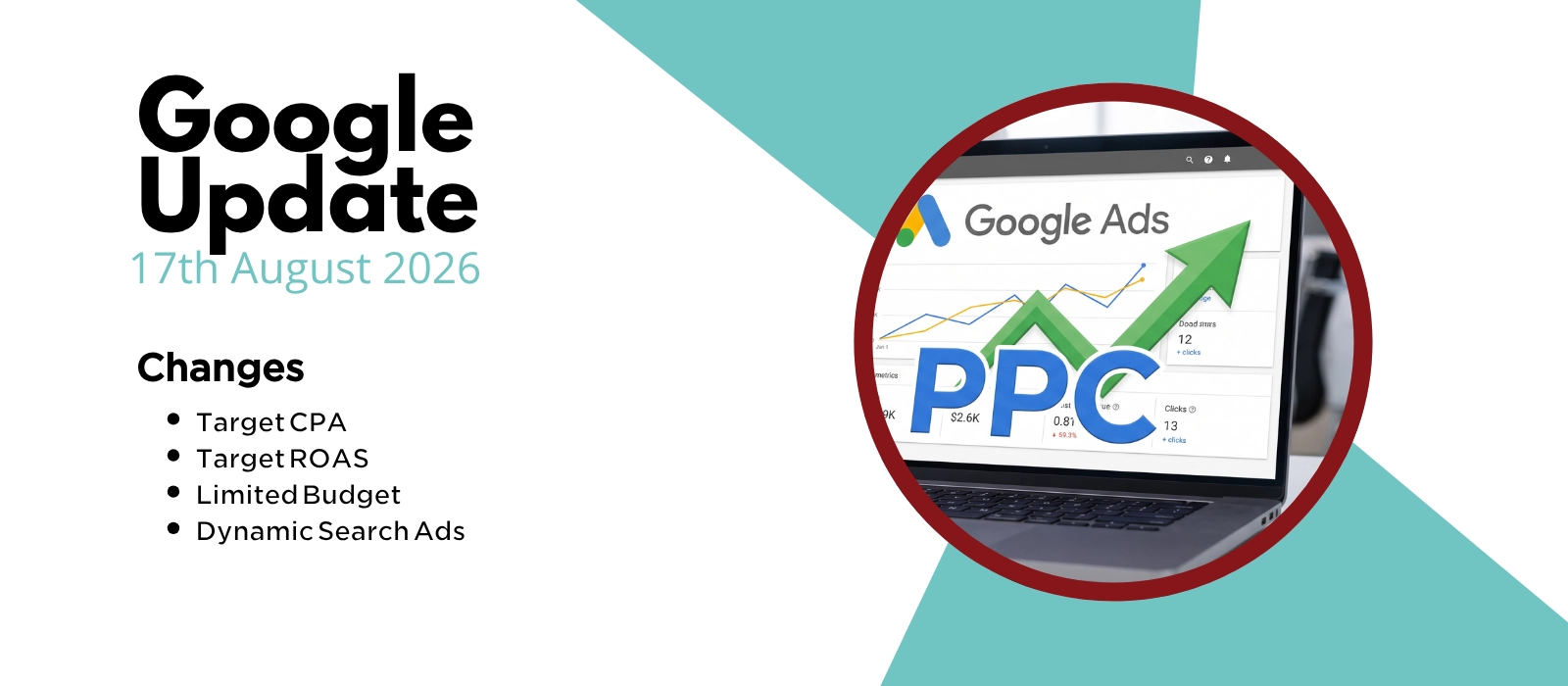
If you run Google Ads as one of your main routes to market, you have probably seen the little notification on your dashboard. This should help clarify the changes and give you easy access to Google support (docs added at the bottom).
From 17 August 2026, Google is changing how it treats the targets you set for your campaigns, and this change will happen automatically. There is no opt-in and no opt-out.
Here is an overview, with two real examples and a simple set of options depending on where you sit.
What's actually changing
| What's changing | When | Who it affects | What it means |
|---|---|---|---|
| How Target CPA and Target ROAS behave when a campaign is short on budget | From 17 August 2026 | Search, Performance Max and Demand Gen campaigns using Target CPA or Target ROAS | If a campaign has been getting a better deal than the target you set, because it didn't have enough budget to spend properly, that bonus stops (this was direct from a Google rep). Performance moves toward the number you actually typed in. |
| Dynamic Search Ads, automatically created assets and broad match settings move to AI Max | From September 2026. New Dynamic Search Ads campaigns can no longer be created after that. Full switchover now pushed back to February 2027 | Search campaigns | If you're still running Dynamic Search Ads, your website content becomes the main signal Google uses to write your ads. It's worth reviewing this before it happens to you rather than after. |
| Minimum audience size for Customer Match | Already live | Search, Display, YouTube | You can now target, or exclude, a list of as few as 100 people, down from 1,000. Useful if you have a small but valuable email or customer list you've never been able to use before. |
Why your website content matters more than ever, and how Hubbi helps
The Dynamic Search Ads change is part of a bigger shift. More and more, Google's systems build your ads and match searches based on what's actually on your website, not just the keywords and headlines you've typed in. A thin, one page lander gives Google very little to work with, and gives your visitors very little reason to trust you either. A proper page, with real content about your brand, gives both a lot more to work with.
Using Hubbi, and the new Claude co-work integration, will help you build proper long form pages and small websites for your brands instead of simple landers. More content, more opportunities, more trust.
Two real examples
We looked at two of our own campaigns before writing this. One had a money problem (limited by budget). The other had a price problem (limited by target), same warning from Google, two completely different causes.
Example 1: the money problem (legacy Excite brand)
This campaign was missing 72% of the traffic it could have had, simply because its daily budget ran out before the day did. Its target price per result was realistic. It just didn't have enough money behind it to reach very far.
If nothing changes, it keeps missing most of its opportunity. If the budget goes up, it can capture more of that missing 72%, at roughly the same cost per result it's already getting. This is a budget problem, not a targeting problem. The fix is simple: give it more room to spend, if you can afford to.
Example 2: the price problem (legacy Affinity brand)
This campaign was missing 84% of its potential traffic, but almost none of that was down to budget. It had plenty of money left over each day. The real problem was its target: the price it said it was willing to pay was lower than what it actually costs to compete for that audience. It kept losing the auction on price, not running out of cash.
If nothing changes, it keeps losing most auctions, and its results will likely shrink rather than grow. The fix here is different: the target itself needs to be more realistic, not the budget.
Same warning from Google. Two completely different causes. That's the bit worth remembering before you touch anything.
Your options
You don't have to accept whatever Google suggests. Here's what each choice actually does.
| Option | What it does | Who it's for |
|---|---|---|
| Do nothing | Your campaign drifts toward whatever target is currently set, even if that's not the number you'd choose today | Only if you're confident your current target is exactly right, right now |
| Match your target to what you're actually getting | Performance should stay close to what you're seeing right now | Campaigns that have quietly been getting a better deal than their stated target |
| Set your own target | You choose a number based on what you can genuinely afford per signup or sale | Anyone who's worked out their real cost per user, including what happens after the first payment |
| Add budget | More of your missed opportunity gets captured, usually at a similar cost per result | Campaigns with a money problem, not a price problem, see example 1 |
| Switch to Maximise Conversions or Maximise Conversion Value | No fixed target. Google spends your budget to get as many results as possible, and your cost per result will move around more | If total results matter more to you than a fixed price per result |
| Manual CPC or Target Impression Share | Not affected by this change at all. You set the price yourself | If you'd rather not hand pricing control to an algorithm |
Before you just add budget
More budget does not always mean more revenue. Plenty of accounts hit a ceiling, where extra spend just buys weaker traffic instead of more real users. If you've ever doubled a budget and seen the same results come back, you've probably found yours.
Tighter keyword sets (which is more challenging nowadays, but achievable), harder negative keyword discipline, and better landing page quality will help raise the ceiling itself, rather than just pushing more spend through the same one. Improvements here lead to higher quality scores, increase ad rank and should lower the CPA. That's a slower fix than adding budget, but it's the one that actually moves the needle, instead of buying a volume of poor quality users that do not upgrade.
What to actually do this week
- Open your account and check for the "Limited by budget" notification, if you have one. It shows you exactly which campaigns are affected and what Google is suggesting.
- Work out why each flagged campaign is limited. Money problem or price problem? The fix is different for each, see above.
- Only add budget where you can genuinely afford more spend, and you're confident it will come back to you, especially if you rely on repeat revenue rather than the first sale to turn a profit.
For the full technical detail, Google's own explanation is at the link in the sources section below.
If your brand still runs on a single thin lander, this change quietly raises the cost of that. Hubbi, with the new Claude co-work integration, helps you build proper long form pages and small websites for your brands, so Google has real content to work with and your visitors have a reason to trust you.