
We thought Google's August update had made no difference to our traffic.
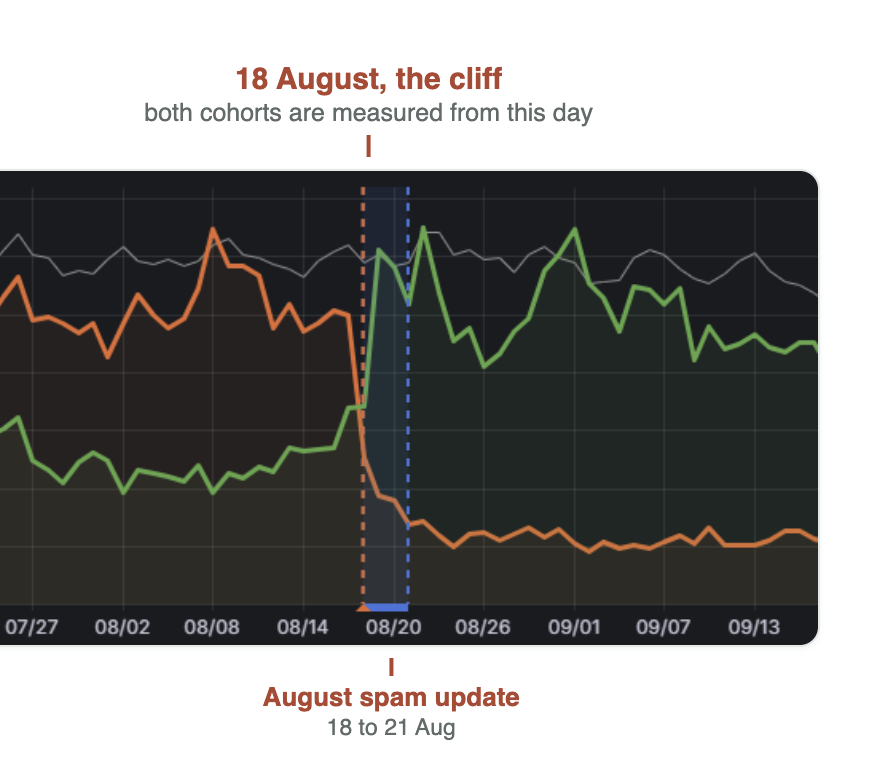
We were wrong. The overall number was hiding something much more interesting. Some brands had gained significantly. Others had fallen off a cliff. Added together, they cancelled each other out, and the total looked flat.
So we started looking at what the winners and the losers had in common. There wasn't one magic factor, but there was a pattern.
Two cohorts, one update
The green cohort: brands that had been actively developed
They had fresher and deeper content, better technical SEO and structured data, and much more information explaining what the brand was, who it was for, how it worked and why somebody should use it.
A significant proportion had also been using our newer Agentic toolkit to develop content specifically around SEO, AEO and visibility within LLMs.
The red cohort: brands that hadn't changed much for some time
Some were effectively a one-page landing site around a domain. Others had website copy that hadn't materially changed for years, limited structured data and very little of the contextual information that helps Google, and increasingly LLMs, properly understand a brand.
Recency, depth and context increasingly matter.
SEO isn't dead. It's expanding.
There's a popular narrative that SEO is dead, and that the days of generating meaningful "free" traffic are behind us. What we're seeing across HubPeople suggests something quite different.
SEO hasn't disappeared. It's expanding. Good technical SEO still matters, but increasingly you're writing for search engines and AI systems.
Your website needs to answer the questions a person would naturally ask before trying your product:
- Who is this for?
- How does it work?
- What does it cost?
- Why is it different?
- Is it safe?
- How does it compare with the alternatives?
The better you articulate those answers, and structure them so machines can understand them easily, the more context Google, ChatGPT and other AI platforms have when deciding when and where your brand is relevant.
And this isn't only about organic traffic. Those same foundations can support paid acquisition too, improving the relevance of your audience and your ad impression share, because Google's AI has a better idea of who your ideal customer is.
The portfolio advantage
There's another lesson here. Portfolio businesses have an enormous advantage when the rules change.
If you operate one brand and an algorithm moves against you, you have a problem. If you operate a portfolio, you're diversified, but you also have something valuable: your own control group.
At HubPeople, we can look across hundreds of brands, see which ones moved up and which moved down, identify the characteristics they have in common, and turn those observations into practical changes for our partners. We cover them in our free weekly workshops, and this piece comes from one of them.
We can't control the next Google update. But we can learn from every one, and use what the winners are doing to help more of our partners get into the success cohort.
Is your brand in the green cohort or the red one? Hubbi and the Agentic toolkit help you build the deeper, fresher, well-structured content that Google and AI platforms reward. Talk to us about moving your brand across.