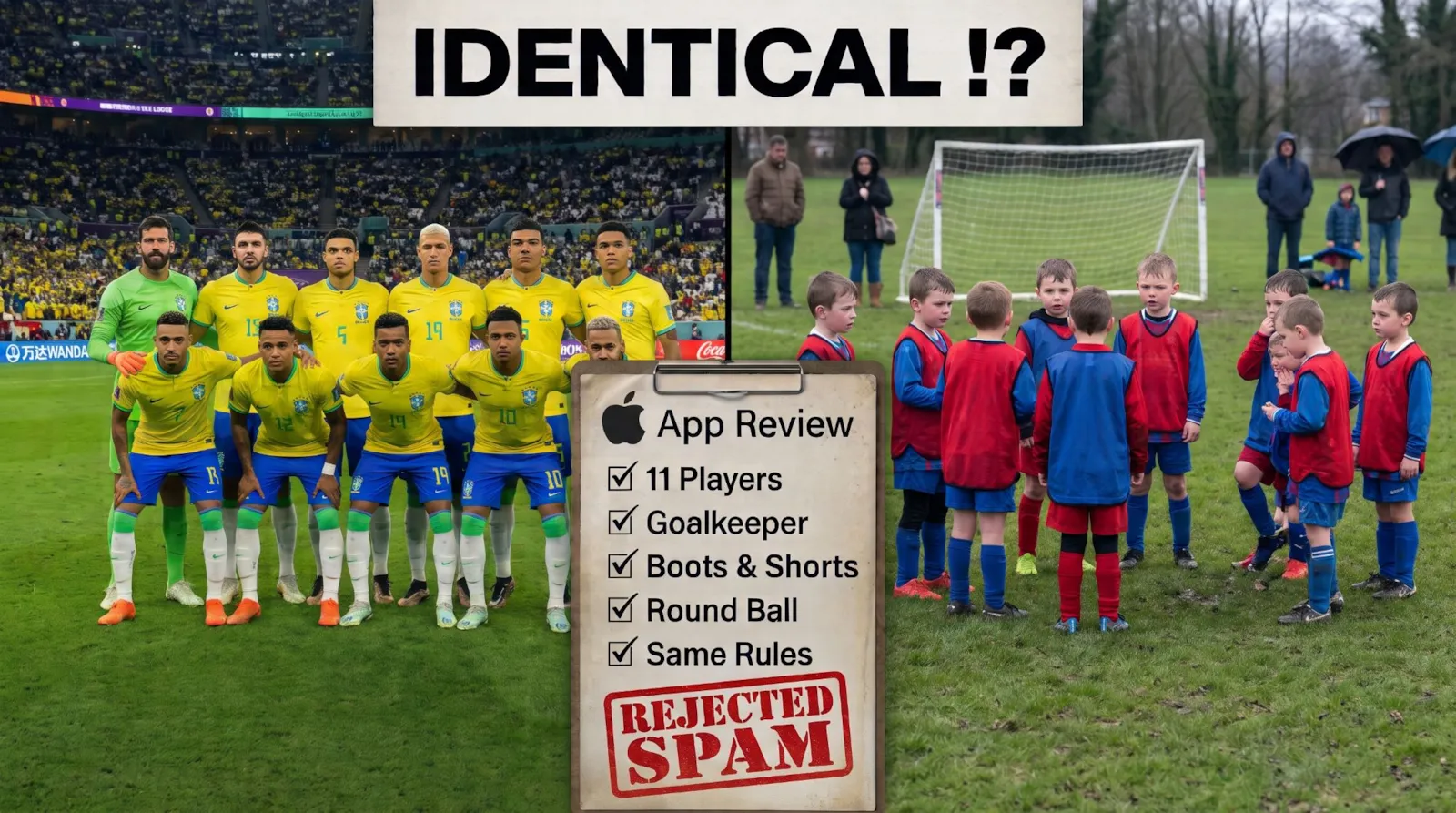

According to Apple, Brazil's national football team and your local Sunday league team are effectively the same product.
Both have 11 players. Both have a goalkeeper. Both wear shorts, kick a round ball and play by the same rules.
Functionally, they're almost identical.
But nobody would seriously suggest they're the same team. It's the people who make them different.
Yet this is effectively the logic Apple is applying to dating apps under its App Store Guideline 4.3.
If your app has profiles, matching, messaging and similar functionality to another dating app, Apple can reject it as "spam", regardless of the distinct community of people it serves.
A wider industry problem
We've experienced this firsthand at HubPeople, including with established dating businesses that have existing customers and simply want to offer their services through an iOS app.
Following discussions with the Online Dating and Discovery Association (ODDA), we understand that other members and prospective members are encountering similar difficulties getting legitimate dating applications approved by Apple.
This isn't an isolated dispute. It's a wider industry problem.
The fundamental problem is that, in dating, the people ARE the product.
A dating app isn't defined by its messaging interface or matching buttons. It's defined by the community of people you can meet.
Treating those communities as interchangeable because they use similar software isn't just commercially absurd. I find it deeply dehumanising.
I can understand rules designed to prevent thousands of copycat games or near-identical apps flooding the App Store. But applying those same rules to genuine communities of human beings completely misses the point.
It goes well beyond dating
Ever wondered why your local kids' football or rugby team doesn't have its own app, in its own colours, with its own recognisable name and badge on your phone?
Apple's restrictions on template-based and similar apps are the reason. Providers of club-management software are pushed towards a single generic app rather than giving every club its own branded presence. The result? Parents searching through generic platforms to find their own team, instead of simply opening an app they recognise.
Less convenient for consumers, less identity for the clubs, and for what tangible benefit?
Apple argues that it wants to avoid cluttering the App Store. But surely search, categorisation, recommendations and filtering are precisely how every modern marketplace solves that problem?
Who does this policy really serve?
There's another question worth asking.
Does this policy genuinely serve consumers, or does it protect Apple's commercial interests and the established incumbents?
Apple controls access to the iOS App Store and earns substantial commissions from transactions within its ecosystem. Restricting the number of competing applications may reduce its review and compliance costs while concentrating commercial activity among fewer, larger operators.
Whether that explains the policy is something Apple should be willing to address.
What concerns me is the competitive effect: established dating brands retain access to consumers, while smaller businesses and new entrants can be excluded ENTIRELY for offering the same basic functionality.
That raises serious questions about gatekeeping, competition and potential antitrust implications.
Where the line should be
Apple should enforce safety, privacy, security and quality standards. Absolutely.
But it shouldn't be deciding which legitimate dating communities deserve to exist based on whether their software looks sufficiently different from that of their competitors.
That decision belongs to consumers, in a properly functioning competitive marketplace, not to a technology company controlling access to it.
An appeal to my network
Finally, an appeal to my network.
If anyone reading this works within Apple's App Store policy or review teams, or knows someone who does and might be able to influence how these rules are interpreted, I'd genuinely welcome a conversation.
I'm happy to share specific examples of established, legitimate dating businesses being rejected and explain why the current interpretation of these rules is so damaging.
Please reach out or DM me. I'd much rather see a sensible policy review than continue fighting individual application rejections.
And I'd be interested to hear from other developers and businesses encountering similar problems.
Has your dating app been rejected by Apple under Guideline 4.3? Or can you help open a conversation with the App Store policy team? Michael would like to hear from you.